Right now, as you sit reading this — completely still, feet on the floor — you are moving faster than a fighter jet. Much, much faster.
How fast is Earth moving? The answer isn’t just one number. It’s actually five different speeds happening all at once, stacked on top of each other like invisible layers. And when you add them all up, the total is almost impossible to wrap your head around.
Let’s break it down — speed by speed.
1. Earth Spins at About 1,000 mph — Right Under Your Feet
Earth rotates once every 24 hours. That sounds slow. But the Earth is enormous, so the surface at the equator has to cover roughly 24,901 miles in just one day.
Do the math: that’s about 1,040 miles per hour (1,670 km/h).
That’s faster than the speed of sound — which is only about 767 mph. how fast is Earth moving
Now, if you live closer to the poles — say in Canada or Scandinavia — your speed is a little slower. The Earth narrows toward the poles, so there’s less distance to cover. Someone standing exactly at the North or South Pole? They’re technically just spinning in place, barely moving at all.
This spin is also why we have day and night. One side of Earth faces the Sun, the other is in darkness. As we spin, we move in and out of sunlight roughly every 12 hours.
So the next time someone says “sit still,” feel free to remind them — that’s physically impossible.
2. Earth Orbits the Sun at 67,000 mph — Every Single Day
While Earth is spinning, it’s also racing around the Sun in a giant oval-shaped path called an orbit.
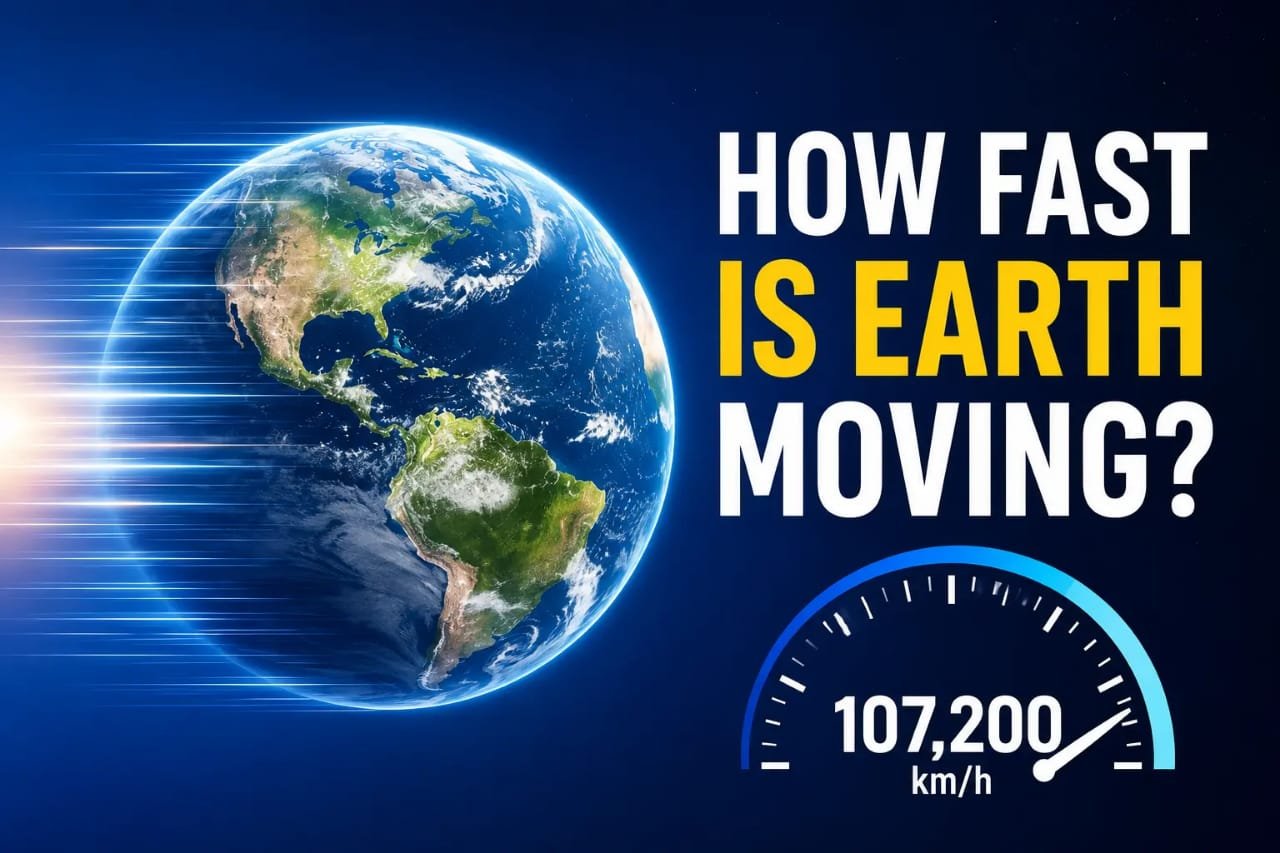
And when scientists ask how fast is Earth moving around the Sun, the answer is breathtaking — approximately 67,000 miles per hour (107,000 km/h).
That’s roughly 18.5 miles every single second.
To put that in perspective: at that speed, you could travel from New York to Los Angeles in about three minutes.
It takes Earth exactly 365.25 days to complete one full lap around the Sun — which is why we have a leap year every four years. That extra quarter-day adds up, and without leap years, our calendar would slowly drift out of season.
So yes — while you’re reading this, Earth has already moved several thousand miles through space.
3. Our Solar System Orbits the Galaxy at 514,000 mph
Here’s where things start to get really wild.
The Sun — along with Earth and everything else in our solar system — is not sitting still in the Milky Way. It’s orbiting the center of the galaxy, just like Earth orbits the Sun.
And this time, the speed is absolutely staggering: about 514,000 miles per hour (828,000 km/h).
Even at this incredible speed, it still takes our solar system approximately 225 to 250 million years to complete one full orbit around the Milky Way. Scientists call this a Cosmic Year or a Galactic Year.
The last time Earth was in this exact position in the galaxy? Dinosaurs didn’t even exist yet. The first dinosaurs were still 20 million years in the future.
That’s how enormous the Milky Way truly is.
4. The Milky Way Itself Is Moving at 1.3 Million mph
You thought we were done? Not even close.
The entire Milky Way galaxy — all 200 billion stars, all our planets, everything — is being pulled toward a massive concentration of matter called the Great Attractor.
The Milky Way is hurtling through the universe at roughly 1.3 million miles per hour (2.1 million km/h).
Scientists actually discovered this by studying the Cosmic Microwave Background — the faint afterglow of the Big Bang that still fills the universe. By measuring tiny temperature differences in this radiation, they could calculate how fast and in which direction our galaxy is moving.
It’s one of the most mind-bending discoveries in modern astronomy — and most people have never even heard of it.
5. The Universe Itself Is Expanding — And It’s Accelerating
Finally, there’s one more layer to this cosmic speed story.
The universe is expanding. And not just expanding — it’s expanding faster and faster over time, driven by a mysterious force scientists call dark energy.
In fact, galaxies at the very edge of the observable universe are moving away from us faster than the speed of light. Not because anything is actually traveling that fast — but because space itself is stretching.
This means asking “how fast is Earth moving” in the context of the entire universe doesn’t have one clean answer. It depends on your reference point. And in an expanding universe, there’s no single fixed point to measure from.
Einstein saw this coming. His theory of General Relativity predicted that space and time could bend, stretch, and expand. Turns out, he was right.
So, How Fast Is Earth Moving Right Now — Total?
If you add up all these motions, the combined speed is somewhere around 1.3 to 1.4 million miles per hour, depending on how you measure it.
Here’s a quick summary:
| Motion | Speed |
|---|---|
| Earth’s rotation (at equator) | ~1,040 mph |
| Earth orbiting the Sun | ~67,000 mph |
| Solar system orbiting the Milky Way | ~514,000 mph |
| Milky Way moving through universe | ~1,300,000 mph |
And yet — you feel none of it. No wind. No turbulence. No sense of motion whatsoever.
That’s because everything around you is moving at exactly the same speed. The ground, the atmosphere, the buildings, the air — all of it is moving together. It’s the same reason you don’t feel like you’re moving when you’re sitting in a smoothly flying airplane.
Physics calls this inertia. Newton figured it out back in 1687.
Why Don’t We Feel Any of This?
This is the question most people ask — and honestly, it’s the best question.
The key is that Earth’s motion is incredibly smooth and consistent. There are no sudden accelerations or sharp turns. Everything changes so gradually — over hours, days, and millions of years — that our bodies can’t detect it.
Our sense of motion only registers when something changes — when you speed up, slow down, or turn. Earth does all of these things too, but so slowly that no human could ever feel it without instruments.
In fact, the only motion you could theoretically feel is Earth’s rotation — and even that is just 0.003 times the force of gravity at the equator. Far too small for any human to notice.
One Last Thing That Will Blow Your Mind
In the time it took you to read this article — maybe five or six minutes — Earth traveled roughly 6,700 miles around the Sun alone.
You didn’t go anywhere. And yet you’ve been on quite a journey.
Space is big. Time is strange. And our small blue planet is flying through all of it at speeds that most of us will never truly feel — but can at least try to imagine.
Science is full of numbers that seem unreal. But Earth’s speed isn’t a theory — it’s a measurement. And every instrument we have confirms it. We are passengers on a spinning, flying, racing planet, in a spinning, flying, racing galaxy. And somehow, it all feels perfectly still.