Have you ever looked up at the night sky and wondered — just how big is the Milky Way? Most of us know it’s large. But the real answer? It’s almost too enormous for the human brain to process.
We live inside this giant galaxy, yet we know surprisingly little about its true scale. Scientists have spent decades trying to measure it, and every new discovery makes it seem even bigger than before.
Let’s break it down in a way that actually makes sense.
What Exactly Is the Milky Way?
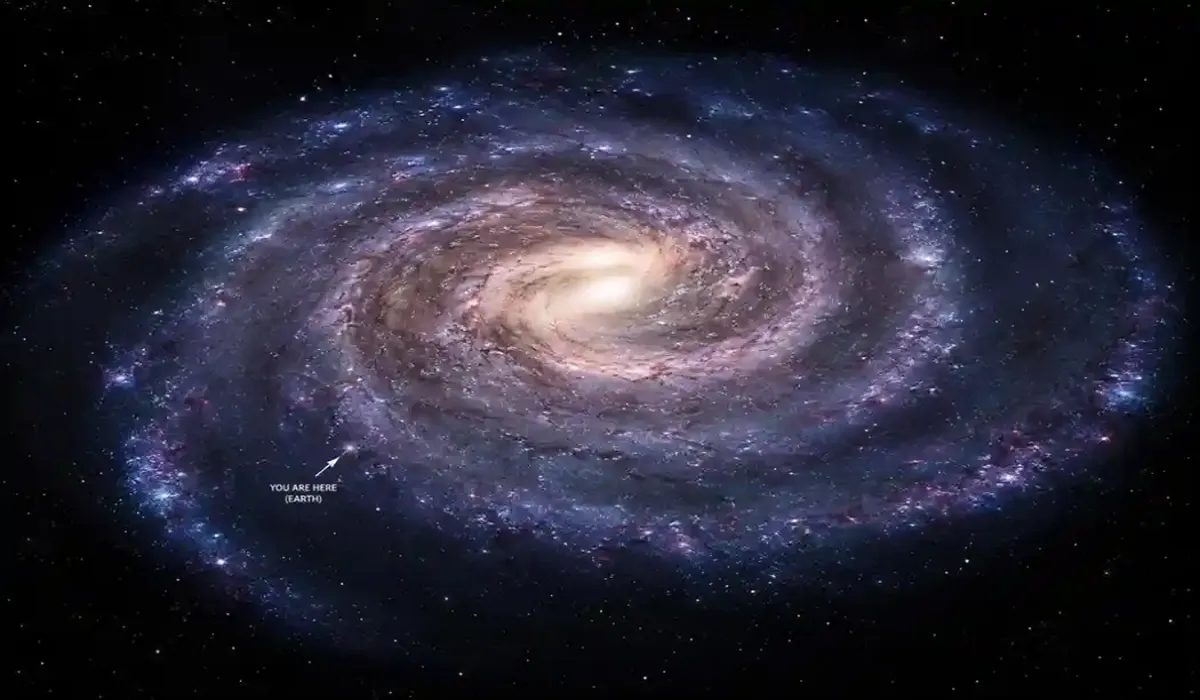
Before we talk size, let’s get one thing straight. The Milky Way is the galaxy we call home. It’s a barred spiral galaxy — meaning it has a central bar-shaped core with massive spiral arms stretching outward in all directions.
Our solar system sits on one of those arms, called the Orion Arm. And we’re not even close to the center. We’re about two-thirds of the way out from the middle.
Think of it like living in the suburbs of a city you’ve never fully seen.
How Big Is the Milky Way, Really?
Here’s where things get wild.
The Milky Way is approximately 100,000 light-years wide. One light-year is the distance light travels in a full year — roughly 5.88 trillion miles. Now multiply that by 100,000.
That number is so big, it honestly stops feeling like a number.
In terms of thickness, the galaxy’s disk is around 1,000 light-years thick at most points. But the outer halo — the invisible cloud of dark matter and old stars surrounding the galaxy — stretches out to nearly 2 million light-years.
Some recent studies from 2023 even suggest the Milky Way could be larger than we previously thought, with outer spiral arms pushing the boundary further than expected.
How Many Stars Are Inside the Milky Way?
This is one of those facts that sounds made up — but it isn’t.
The Milky Way contains an estimated 100 to 400 billion stars. Our Sun is just one of them. A single, ordinary, middle-aged star sitting quietly in one of the galaxy’s outer arms.
Beyond stars, scientists believe there are likely billions of planets orbiting those stars. Many of them may be in the habitable zone — the right distance from their star for liquid water to exist.
The possibility of life out there? Statistically, it feels almost certain. We just haven’t found it yet.
How Long Would It Take to Cross the Milky Way?
Let’s put the size into a real perspective.
If you could travel at the speed of light — which is 186,000 miles per second — it would still take you 100,000 years just to cross from one end of the galaxy to the other.
Our fastest spacecraft ever built, the Parker Solar Probe, travels at about 430,000 miles per hour. At that speed, crossing the Milky Way would take roughly 1.4 billion years.
So yeah. It’s big.
How Old Is the Milky Way?
Size isn’t the only thing that’s staggering. Age is too.
The Milky Way is approximately 13.6 billion years old. That’s almost as old as the universe itself, which formed around 13.8 billion years ago.
Our solar system, by comparison, is only about 4.6 billion years old. The Milky Way was already ancient by the time Earth was even born.
Where Are We Inside the Milky Way?
Finding our exact location took scientists a long time — partly because we’re inside the galaxy looking out, which makes it hard to map.
We now know Earth is located about 26,000 light-years from the galactic center. That center is home to a supermassive black hole called Sagittarius A*. It has a mass equal to 4 million suns.
And yes, it’s pulling everything around it — including us — in a slow orbit. Our solar system completes one full trip around the galactic center every 225–250 million years. That journey is called a galactic year.
Is the Milky Way the Biggest Galaxy?
Not even close.
The Milky Way is actually considered a mid-to-large-sized galaxy. But when compared to some of its neighbors, it gets humbled fast.
The Andromeda Galaxy — our nearest major neighbor — is estimated to be 220,000 light-years wide, more than twice the size of the Milky Way.
And then there’s IC 1101, one of the largest known galaxies in the observable universe. It stretches nearly 6 million light-years across. Compared to that, the Milky Way is a small town next to a continent.
7 Quick Mind-Blowing Milky Way Facts
Here’s a fast summary of everything that should be keeping you up at night:
- The Milky Way is 100,000 light-years wide
- It contains up to 400 billion stars
- It’s 13.6 billion years old
- Earth is 26,000 light-years from the center
- A supermassive black hole sits at its core
- Our solar system orbits the center every 225 million years
- The outer halo stretches nearly 2 million light-years
So, how big is the Milky Way? Big enough that no human will ever fully explore it. Big enough that our entire recorded history fits into a fraction of a single galactic year. Big enough to make every problem feel a little smaller.
There’s something strangely comforting about that. We’re tiny — but we’re part of something unimaginably grand.
And the more we learn about our galaxy, the more questions seem to appear. Which, honestly, is the best part of science.