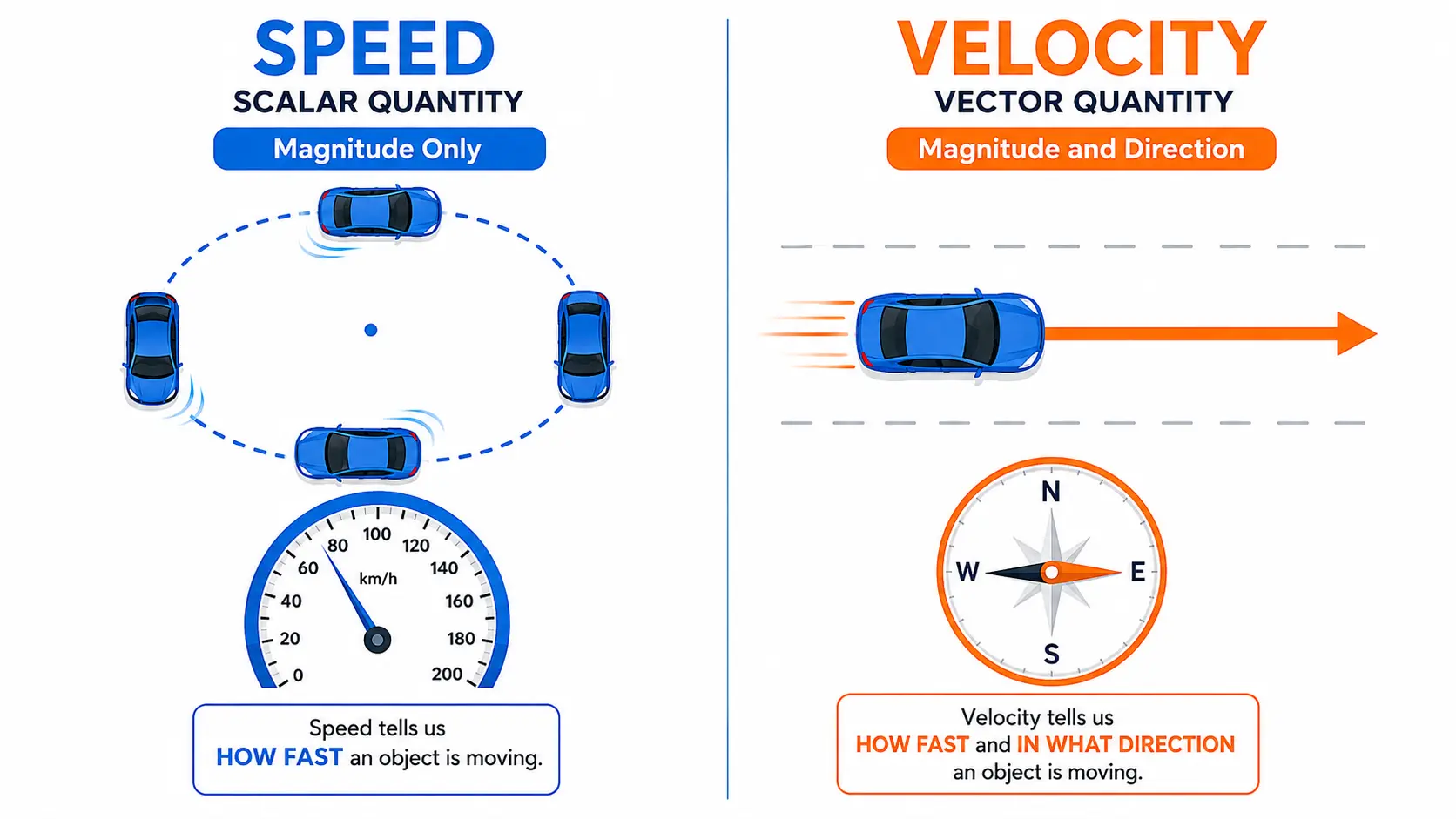
Most students use speed and velocity as if they mean the same thing. Even in everyday conversation, people swap them constantly. But in physics, the difference between speed and velocity is actually huge — and getting it wrong can cost you marks on every exam.
Here is the good news. Once you understand it with real-life examples, you will never mix them up again.
Let’s break it down simply.
What Is Speed?
Speed is how fast an object is moving. That’s it.
It doesn’t care about direction. It only tells you how much distance an object covers in a given amount of time.
The formula is straightforward:
Speed = Distance ÷ Time
So if you drive 100 kilometers in 2 hours, your speed is 50 km/h. Simple.
Speed is what scientists call a scalar quantity — meaning it only has a magnitude (a number value). There is no mention of which direction you are heading. North, south, left, right — speed doesn’t care.
What Is Velocity?
Velocity takes things one step further.
Velocity is speed with direction. It tells you not just how fast something is moving, but also which way it is going.
Velocity = Displacement ÷ Time
Notice the word displacement instead of distance. That difference matters a lot — and we’ll get to it in a moment.
Velocity is a vector quantity — meaning it has both magnitude and direction. For example, “60 km/h heading north” is a velocity. “60 km/h” alone is just a speed.
Key Difference Between Speed and Velocity
Here is where the real difference between speed and velocity becomes crystal clear.
Imagine you are running laps around a circular track. You complete one full lap and end up exactly where you started.
- Your speed was definitely not zero — you were running the whole time
- But your velocity? It could be considered zero — because your overall displacement from start to finish is nothing
That single example explains everything.
Speed measures total distance covered. Velocity measures displacement — the shortest path between your starting point and ending point, in a specific direction.
5 Simple Facts That Explain It All
Let’s lock this in with five clean facts:
1. Speed has no direction. Velocity does. Speed only tells you how fast. Velocity tells you how fast and which way.
2. Speed uses distance. Velocity uses displacement. Distance is the total path traveled. Displacement is the straight-line change in position.
3. Speed is always positive. Velocity can be negative. If you move backwards, your velocity becomes negative — showing reverse direction. Speed stays positive regardless.
4. Speed is a scalar. Velocity is a vector. Scalars have only magnitude. Vectors have both magnitude and direction. This is the core physics difference between the two.
5. You can have speed without velocity — but not the other way around. An object moving in a circle at constant speed has changing velocity — because the direction keeps changing, even if the speed stays the same.
Real Life Examples That Make It Click
Sometimes textbook definitions just don’t stick. So let’s look at real situations.
Example 1 — The Car on a Straight Road
A car travels 80 km/h on a straight highway heading east.
- Speed = 80 km/h
- Velocity = 80 km/h, East
Here both values are similar, but velocity has that extra piece — the direction.
Example 2 — Walking in a Circle
A person walks around a circular park at 5 km/h and returns to the same bench after 30 minutes.
- Speed = 5 km/h (they were always moving)
- Velocity = 0 km/h (displacement is zero — start and end point are the same)
This surprises a lot of people. But it perfectly shows the difference between speed and velocity in action.
Example 3 — A Ball Thrown Upward
You throw a ball straight up into the air.
- On the way up, velocity is positive (moving upward)
- At the highest point, velocity is zero for a split second
- On the way down, velocity is negative (moving downward)
Speed, on the other hand, only shows the magnitude — it would be the same at the same heights on the way up and on the way down, even though the direction has flipped.
Speed vs Velocity — Quick Comparison Table
| Feature | Speed | Velocity |
|---|---|---|
| Type | Scalar | Vector |
| Direction | No | Yes |
| Formula | Distance ÷ Time | Displacement ÷ Time |
| Can be zero? | Only if not moving | Even while moving |
| Can be negative? | No | Yes |
| Example | 60 km/h | 60 km/h, North |
Why Does This Difference Actually Matter?
You might think this is just a technicality for physics exams. But it actually has very real-world importance.
GPS Navigation uses velocity — not just speed. It needs to know your direction to route you correctly. Speed alone would be useless.
Aerospace engineering depends entirely on velocity calculations. A rocket going “fast” in the wrong direction is a catastrophic failure. Direction is everything.
Weather forecasting uses wind velocity — speed and direction together — to predict where a storm is headed. Wind speed alone doesn’t tell you if the hurricane is moving toward the coast or away from it.
Even in sports, analysts track player velocity to understand sprint direction during a match — not just how fast a player is running.
Common Mistakes Students Make
Let’s quickly cover the errors that show up again and again in exams.
Mistake 1 — Using distance and displacement interchangeably Remember: distance is the full path traveled. Displacement is only the net change in position with direction. Always identify which one applies before calculating.
Mistake 2 — Thinking constant speed means constant velocity This is wrong. An object moving in a circle has constant speed but constantly changing velocity — because direction keeps changing.
Mistake 3 — Forgetting direction in velocity answers If an exam question asks for velocity and you only write a number without direction, your answer is incomplete. Always include direction — north, south, upward, at 30°, etc.
The difference between speed and velocity comes down to one word — direction.
Speed doesn’t have it. Velocity does.
Once you internalize that, everything else falls into place naturally. The formulas make more sense. The examples click. And those tricky exam questions that once felt confusing suddenly become straightforward.
Physics has a way of making the world feel more logical — and understanding the difference between speed and velocity is one of the first steps in that direction. Quite literally.