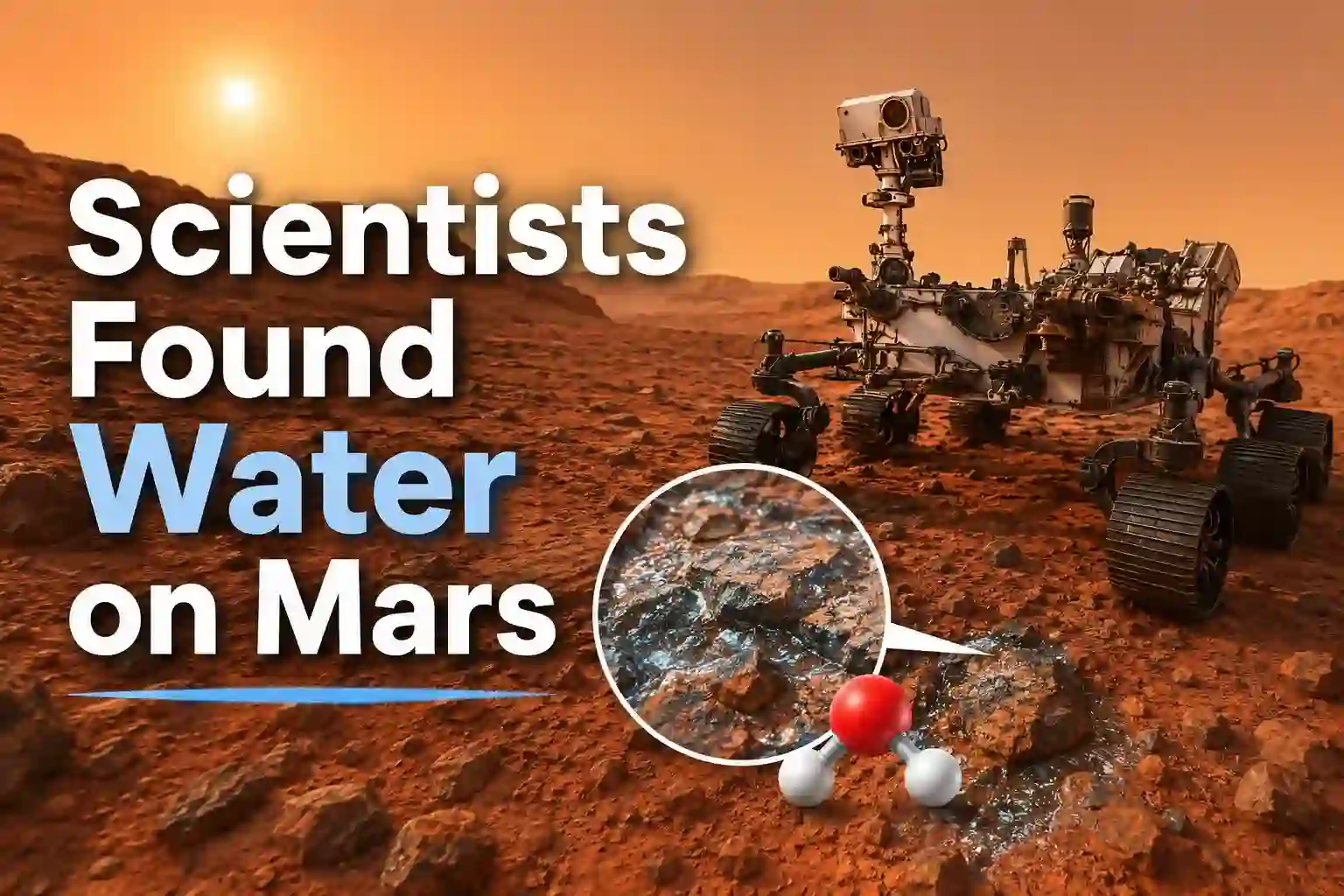
Scientists found water on Mars — and this time, the evidence is unlike anything we’ve seen before.
For decades, the idea of water on Mars felt like a distant dream. A hopeful theory. Something scientists wanted to believe but couldn’t fully prove. But in 2026, that story is rapidly changing — and the discoveries coming out right now are genuinely stunning.
Let’s walk through what researchers have actually found, what it means, and why the world is paying attention.
The Bathtub Ring That Changed Everything
In April 2026, scientists published a groundbreaking study in the journal Nature that stopped the astronomy world in its tracks.
Must Read:
Using data collected by a NASA probe that spent a full decade orbiting Mars, researchers identified a massive geological structure stretching across the Martian surface. They called it a “bathtub ring” — and the name makes perfect sense.
Scientists detected what might be the contours of a long-lost ocean on Mars, and their research points to a Martian equivalent of the continental shelf — the kind of boundary that defines where Earth’s oceans meet the land.
Think about what happens when a bathtub drains. A ring of residue is left behind, marking exactly where the water level once sat. That is precisely what scientists believe they are looking at on the surface of Mars. A ring left behind by an ocean that may have existed billions of years ago.
“The possible existence of an ocean suggests that a large body of water may have persisted for a long time. That could have been an important ingredient for life,” researchers noted in the study.
That line alone is worth sitting with for a moment.
How Big Was This Ancient Martian Ocean?
Here is where it gets truly jaw-dropping.
A huge geological structure on Mars resembling a bathtub ring may be evidence of an ocean that once covered a third of the Red Planet’s entire surface.
One third. Of an entire planet.
A coastal shelf could have formed over millions of years as rivers dumped sand and mud into the ocean, waves spread those sediments around, and sea levels rose and fell over time.
This wasn’t just a puddle or a small frozen lake. If the research holds up, Mars once had a genuine, massive ocean — complete with shorelines, tides, and sedimentary rock formations strikingly similar to what we find on Earth today.
What Scientists Found Beneath the Surface ( Scientists Found Water on Mars )
The bathtub ring discovery wasn’t the only breakthrough this year.
Researchers at New York University Abu Dhabi discovered new clues suggesting that water once moved beneath the surface of Mars.
The research, published in the Journal of Geophysical Research — Planets, focuses on ancient sand dunes located in Gale Crater, an area explored by NASA’s Curiosity rover. According to the study, these dunes slowly hardened into rock billions of years ago after interacting with groundwater moving beneath the Martian surface.
What makes this finding especially compelling is the method researchers used to reach their conclusion. The team compared observations from the Curiosity rover with similar rock formations found in the deserts of the United Arab Emirates that formed under comparable conditions on Earth.
In other words, Mars and Earth once shared something remarkable — the kind of wet, active geology where life can take root.
Could Mars Have Supported Life Longer Than We Thought?
This is the question everyone is really asking.
The findings indicate that the Red Planet may have remained capable of supporting life for much longer than scientists once believed.
For years, the scientific consensus was that Mars dried out relatively quickly — that any window of habitability was brief and ancient. These new discoveries challenge that idea directly.
If groundwater was moving beneath the surface, interacting with sediment and reshaping rock formations over extended periods, then Mars wasn’t just wet for a moment. It may have been wet for long enough to matter.
Long enough for something to begin.
The Interstellar Surprise — Water From Beyond Our Solar System
Just when you thought the water story couldn’t get any stranger, researchers threw in something completely unexpected.
In May 2026, scientists studying interstellar comet 3I/ATLAS — only the third interstellar object ever detected entering our solar system — made a remarkable find. The comet contains strange water never seen in our solar system before.
The team concluded that 3I/ATLAS likely formed in a much colder region with lower radiation levels than the environment that created the planets and comets in our solar system.
What this tells us is profound. Water isn’t just something unique to Earth or Mars. It exists across the galaxy, in different forms, born under different conditions, carried through space by objects that have been traveling for millions of years.
As one researcher put it — “This is proof that whatever the conditions were that led to the creation of our solar system are not ubiquitous throughout space.”
Water is everywhere. And it takes forms we haven’t even imagined yet.
5 Key Discoveries Summarized
Here’s a quick breakdown of everything scientists have uncovered recently:
- The Bathtub Ring — A continent-sized geological structure on Mars suggests a real ancient ocean once covered a third of the planet
- Underground Water Movement — Evidence of groundwater flowing beneath Mars’ surface billions of years ago, discovered in Gale Crater
- Extended Habitability — Mars may have been capable of supporting life far longer than previously believed
- Interstellar Water — Comet 3I/ATLAS brought water from outside our solar system — water unlike anything found here before
- Continental Shelf Evidence — Mars shows sedimentary rock formations nearly identical to Earth’s ocean floors
What Happens Next?
“If we sent a rover, we would expect to see sedimentary rocks and structures similar to those found on Earth’s continental shelves, including layering, sloping surfaces, and textures produced by waves and currents,” said lead researcher Abdallah Zaki of the University of Texas.
That’s exactly the next step. Getting boots — or rover wheels — on the ground in these specific locations. The Mars bathtub ring region is now a prime target for future missions. Scientists want to drill down, collect samples, and look for the biological signatures that liquid water makes possible.
NASA, ESA, and private space companies are all watching closely. The scientific pressure to explore these sites is growing by the month.
Why This Matters for All of Us
You might be wondering — why should I care about water on Mars?
Here’s the honest answer. If Mars once had an ocean, and if groundwater moved beneath its surface for billions of years, then the chances of finding some form of ancient microbial life there go from “possible” to “genuinely likely.”
And if life existed on Mars, it changes the most important question humanity has ever asked — are we alone?
The answer, it seems, is slowly shifting.
We’re not just finding water on Mars. We’re finding a world that once looked a lot like our own. A world that may have had its own beginning — and its own story — long before we ever looked up and wondered about it.
Every new discovery about Mars feels like flipping another page of a book we’ve been trying to read for centuries. And right now, in 2026, those pages are turning faster than ever.
Scientists found water on Mars. They found it underground. They found its ancient shoreline. They found water arriving from other star systems entirely.
The universe is soaking wet — and we’re only just beginning to understand what that means.