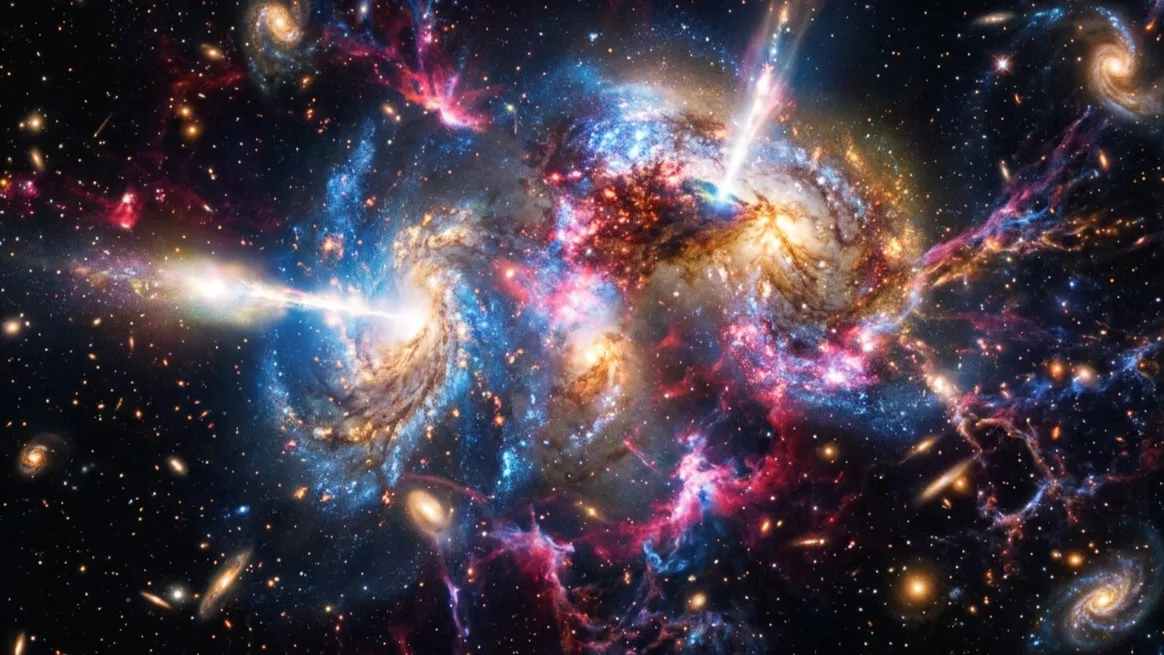
Early universe galaxies : The early universe was anything but quiet. In the cosmic dawn, galaxies blazed like overcrowded cities during a festival night, producing stars at astonishing rates, colliding with neighbors, and feeding gigantic black holes with almost reckless intensity. For decades, astronomers have puzzled over one fundamental question: Why were galaxies so hyperactive shortly after the universe was born?
Now, thanks to a wave of discoveries from powerful observatories such as the and new theoretical models, scientists believe they may finally be approaching an answer.
Table of Contents
The emerging picture suggests that the young universe was filled with unusually dense reservoirs of gas, chaotic gravitational conditions, and a rapid cycle of galactic growth that turned early galaxies into cosmic furnaces. What once looked like astronomical chaos may actually have been a natural consequence of how the universe evolved after the Big Bang.
A Universe in Overdrive Early universe galaxies
To understand the mystery, it helps to travel back nearly 13 billion years. The universe itself is estimated to be about 13.8 billion years old, meaning astronomers observing distant galaxies are essentially looking into the past. Because light takes time to travel, telescopes can capture images of galaxies as they existed billions of years ago.
What scientists found was startling.
Galaxies in the early universe formed stars at rates far greater than most galaxies today. Some created hundreds or even thousands of stars annually, while galaxies like the typically produce only a few new stars each year.
Must Read: James Webb Telescope Discovers Mysterious ‘Red Monster’ Galaxy From the Early Universe
These ancient systems were also rich in glowing gas and dust, packed with turbulent energy, and often powered by actively feeding supermassive black holes. The universe during its first few billion years resembled a gigantic construction zone where matter was assembling itself at breakneck speed.
For years, astronomers debated whether these observations represented unusual exceptions or the normal behavior of early galaxies. Increasing evidence now suggests this activity was widespread.
The Fuel Behind the Frenzy
At the center of the new explanation lies one crucial ingredient: cold hydrogen gas.

Stars are born when clouds of gas collapse under gravity. In the modern universe, many galaxies have already used up large portions of their gas supply. But in the early cosmos, galaxies were swimming in enormous reservoirs of fresh material.
Scientists now think the young universe contained vast “cosmic rivers” of gas flowing through invisible structures made of dark matter. These streams continuously fed galaxies, providing them with almost unlimited fuel for star formation.
Imagine a campfire being constantly supplied with fresh wood. Instead of burning out, it grows hotter and brighter. Early galaxies behaved in much the same way.
Recent observations from the have strengthened this theory by detecting surprisingly massive galaxies that existed much earlier than scientists expected. Many appear rich in gas and dust, suggesting they were rapidly converting raw material into stars.
The telescope’s infrared capabilities allow astronomers to peer through ancient cosmic dust clouds that older instruments struggled to penetrate. What they are seeing is forcing researchers to rethink how quickly galaxies formed after the Big Bang.
Gravity’s Violent Role
Another major factor may have been the crowded nature of the young universe itself.
Billions of years ago, galaxies were much closer together than they are today. That meant collisions and mergers happened frequently. When galaxies smash into one another, gravity compresses gas clouds and triggers explosive bursts of star formation.
These mergers also help channel matter toward central black holes, causing them to grow rapidly and emit enormous amounts of radiation. Some of the brightest objects in the universe, known as quasars, emerged during this era.
Far from being rare cosmic accidents, these collisions may have been part of normal galactic evolution.
Astronomers increasingly believe that galaxy mergers acted like giant gravitational mixers, stirring up gas and accelerating star birth across the universe. In some cases, the collision of two relatively small galaxies may have created entirely new giant systems in only a few hundred million years.
The early universe was essentially a cosmic traffic jam, and galaxies rarely evolved in isolation.
The Dark Matter Connection
One of the most intriguing pieces of the puzzle involves dark matter, the invisible substance thought to make up most of the universe’s mass.
Although dark matter cannot be seen directly, scientists know its gravity shapes galaxies and cosmic structures. Early dark matter “halos” likely acted as enormous gravitational traps, pulling in gas from surrounding space.
The stronger and denser these halos were, the faster galaxies could gather material and grow.
Some researchers believe dark matter structures in the young universe were especially efficient at funneling gas inward. That may explain why star formation rates were dramatically higher than what astronomers see in nearby galaxies today.
In a way, visible galaxies may have simply been glowing signposts sitting inside gigantic invisible scaffolds of dark matter.
A New Era of Discovery
The reason scientists are now getting closer to answers is simple: they finally have better tools.
For decades, telescopes lacked the sensitivity to clearly observe the earliest galaxies. Much of the ancient universe was hidden behind distance, dust, and faint infrared light.
The launch of the changed that dramatically.
Within months of operation, Webb detected galaxies that appeared unexpectedly mature for their age. Some seemed too large, too bright, and too chemically evolved to fit older theories of galaxy formation.
This has sparked intense debate within the astronomy community. Some scientists argue existing models simply underestimated how quickly galaxies could grow. Others believe entirely new physics may be needed.
At the same time, advanced computer simulations are helping researchers recreate the evolution of galaxies in unprecedented detail. By combining observational data with artificial intelligence and supercomputer modeling, astronomers can now test how gas flows, dark matter, gravity, and black holes interact over billions of years.
The result is a rapidly evolving understanding of cosmic history.
Were Early Galaxies More Efficient?
One especially interesting possibility is that early galaxies were simply better at making stars.
Modern galaxies often lose energy through stellar explosions, black hole activity, and magnetic processes that slow star formation. But conditions in the young universe may have allowed gas to collapse more efficiently.
Higher gas densities, stronger turbulence, and lower concentrations of heavy elements could all have contributed to faster star production.
If true, this would mean the universe experienced a kind of “golden age” of galactic growth during its first few billion years before gradually settling into the calmer cosmic environment we see today.
In many ways, the universe may have followed a life cycle similar to living organisms: an energetic youth followed by a slower and more stable adulthood.
The Mystery Isn’t Fully Solved Yet
Despite the recent breakthroughs, many questions remain unanswered.
Astronomers still do not fully understand how some galaxies became so massive so quickly after the Big Bang. Others wonder whether current measurements are being distorted by dust, brightness effects, or incomplete data.
There is also ongoing debate over the role of supermassive black holes. Did black holes drive early galactic activity, or were they simply passengers caught in the process?
Future observations from Webb and next-generation observatories may provide more clarity in the coming years.
But for the first time, scientists are beginning to see a coherent explanation emerge. The extreme activity of early galaxies may not have been unusual at all. Instead, it could have been the natural outcome of a dense, gas-rich universe shaped by gravity, dark matter, and relentless cosmic growth.
The ancient universe was not calm and orderly. It was a roaring engine room of creation, where galaxies rapidly assembled themselves amid floods of gas and violent collisions.
And after decades of uncertainty, humanity may finally be learning why.